.svg)
.svg)
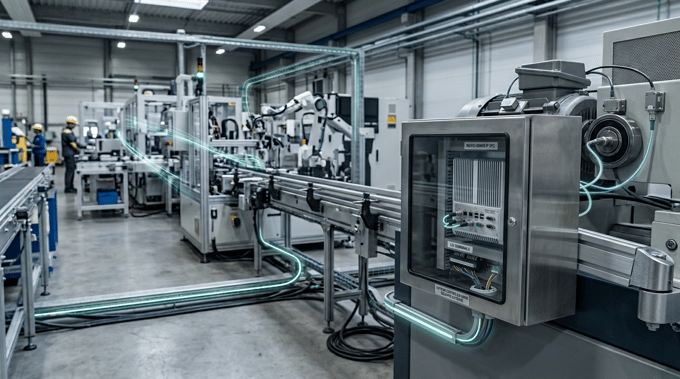
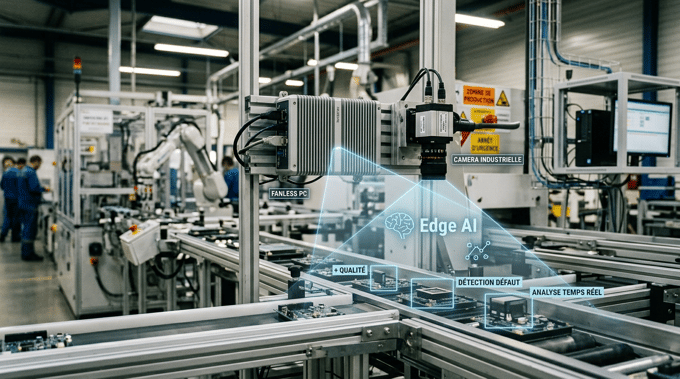
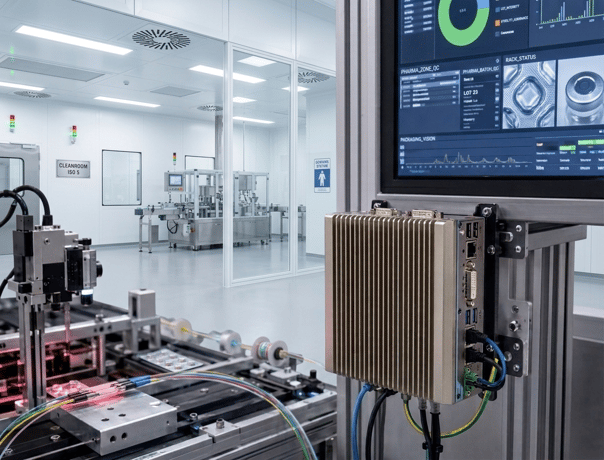
Today, an industrial fanless PC can do much more than just monitoring or data acquisition. Depending on its hardware configuration, it can handle local data processing, edge computing, AI inference, and machine vision—all directly at the point of operation, right next to the machines and equipment.
This evolution addresses a growing need in Industry 4.0: processing more data locally, reducing latency, and leveraging artificial intelligence algorithms without relying solely on a remote server or the cloud. However, not all fanless PCs are capable of handling the same computational workloads. For anEdge AI or machine vision application, the choice of processor, memory, storage, GPU, and communication interfaces becomes critical.
TABLE OF CONTENTS:
1. Can an industrial fanless PC handle edge computing and AI?
2. Fanless PCs for AI: CPU, GPU, or AI accelerator?
3. Machine vision: The fanless PC must handle much more than just AI
4. Memory and Storage: Components That Should Not Be Underestimated
5. How to Size a Fanless PC for AI?
6. Industrial Fanless PCs: What Applications Are Suitable for Edge AI?
7. Which fanless PC series are suitable for edge computing and AI?
Can an industrial fanless PC handle edge computing and AI?
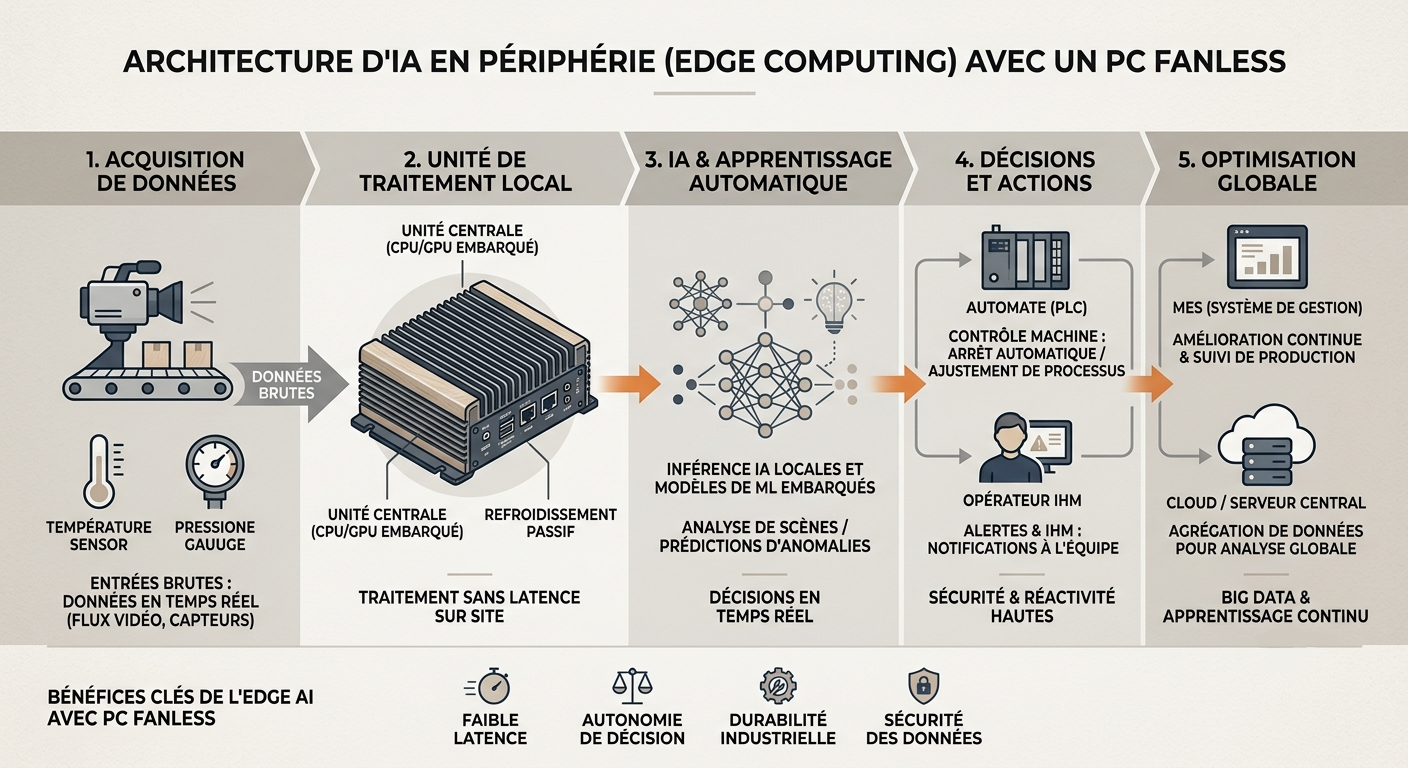
Yes, provided you choose an architecture suited to the computational load. The principle ofindustrial edge computing is to process data directly in the field, at the level of a machine, a production line, or a piece of equipment. The industrial PC collects data from IoT sensors, communication gateways, PLCs, cameras, or other connected devices, and then analyzes it locally.
This architecture makes it possible, in particular, to:
- reduce latency between data acquisition and processing;
- limit data transfers to a server or the cloud;
- store certain sensitive data locally;
- make decisions more quickly;
- continue processing certain data even when the network connection is unavailable.
In an AI application, for example, the PC can run a pre-trained model to perform AI inference directly on the production floor. The fanless PC thus becomes a true embedded computing platform, capable of combining data acquisition, communication, processing, and intelligence within a single device.
To learn about the different architectures, form factors, and configuration options, visit our guide on “ How to choose an industrial fanless PC for your application.”
Why use a fanless PC for industrial Edge AI?
The benefit of a fanless design isn’t just the absence of a fan. For industrial applications, this design primarily helps minimize the number of mechanical components that are prone to wear or require maintenance. However, the choice between passive cooling and fan-based cooling depends on the application’s constraints, particularly in terms of computing power, temperature, and the operating environment. To learn more about this choice, see our article Fanless PC or fan-based PC: Which one should you choose for industrial use?
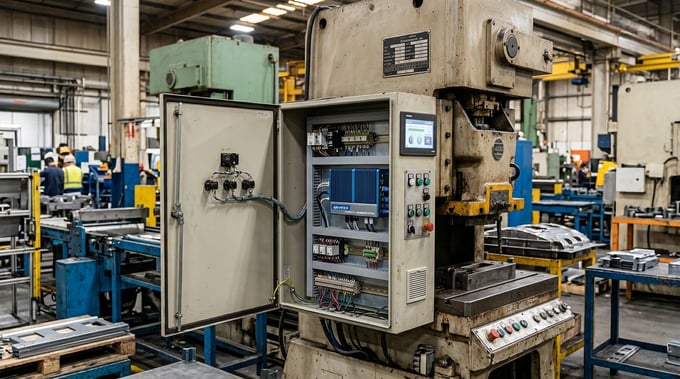
In a dusty or vibration-prone environment, passive cooling can also make it easier to integrate the PC into a machine, a cabinet, or as close as possible to the process. But one constraint immediately arises: the more a processor or AI accelerator is used, the more heat it generates. Cooling therefore becomes a key factor in system design.
A fanless PC designed for Edge AI must be capable of continuously dissipating the heat generated by its components while maintaining the performance required for the application. It is therefore not enough to simply choose the most powerful processor available: you must find the optimal balance between computing power, power consumption, temperature, and integration constraints.
Fanless PCs for AI: CPU, GPU, or AI accelerator?
The processor is the first level of computation in an industrial PC, but it is not necessarily sufficient for the most demanding AI or computer vision applications.
CPU: for General-Purpose Processing and Edge Computing
Intel, AMD, or ARM processors can handle a wide range of industrial applications: monitoring, data acquisition, communication with PLCs, data processing, SCADA, MES, and line-of-business applications.
For relatively light AI processing, certain CPU architectures may also be sufficient, particularly when the models are optimized for inference.
GPUs: to accelerate AI and machine vision
When the application requires more parallel computing power, integrating a GPU may be a viable option. The GPU is particularly well-suited for image processing and artificial intelligence algorithms. It can accelerate operations such as:
- object detection;
- image classification;
- defect recognition;
- video analysis;
- image segmentation;
- automated quality control.
For these applications, however, the choice of GPU and its thermal envelope must be consistent with the fanless architecture.
AI accelerators and Edge platforms
Some industrial architectures also incorporate dedicated AI accelerators or platforms designed specifically for Edge AI. These enable inference models to be executed efficiently directly in the field, while maintaining a compact form factor suitable for industrial integration.
The right choice therefore depends less on seeking maximum power and more on the actual application workload, the models used, and the expected level of performance.
What level of power is needed for a fanless industrial PC?
Not all edge applications require an architecture equipped with a GPU. The power requirement must be determined based on the actual processing tasks performed.
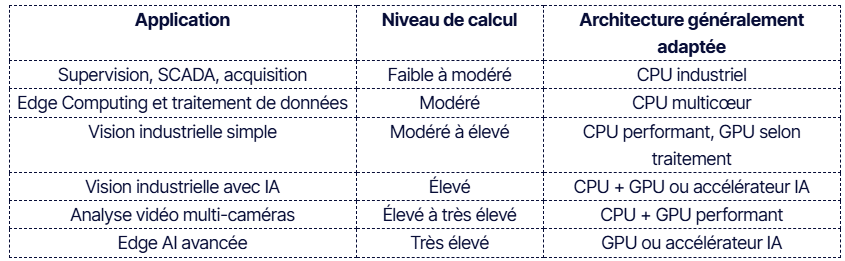
This table provides a preliminary guide. In an industrial project, system sizing must also take into account image resolution, the number of streams, the acquisition rate, the AI model, expected latency, and thermal conditions.
Machine vision: the fanless PC must handle much more than just AI
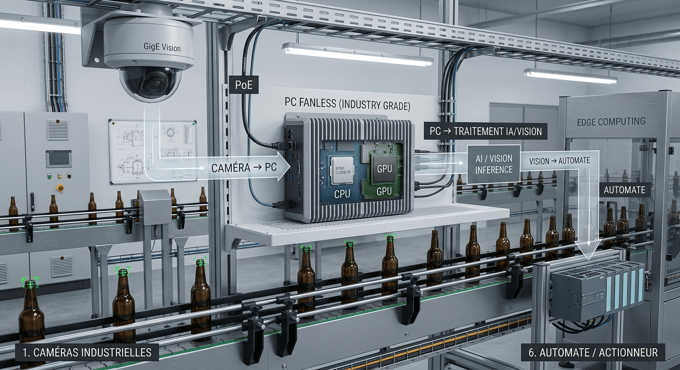
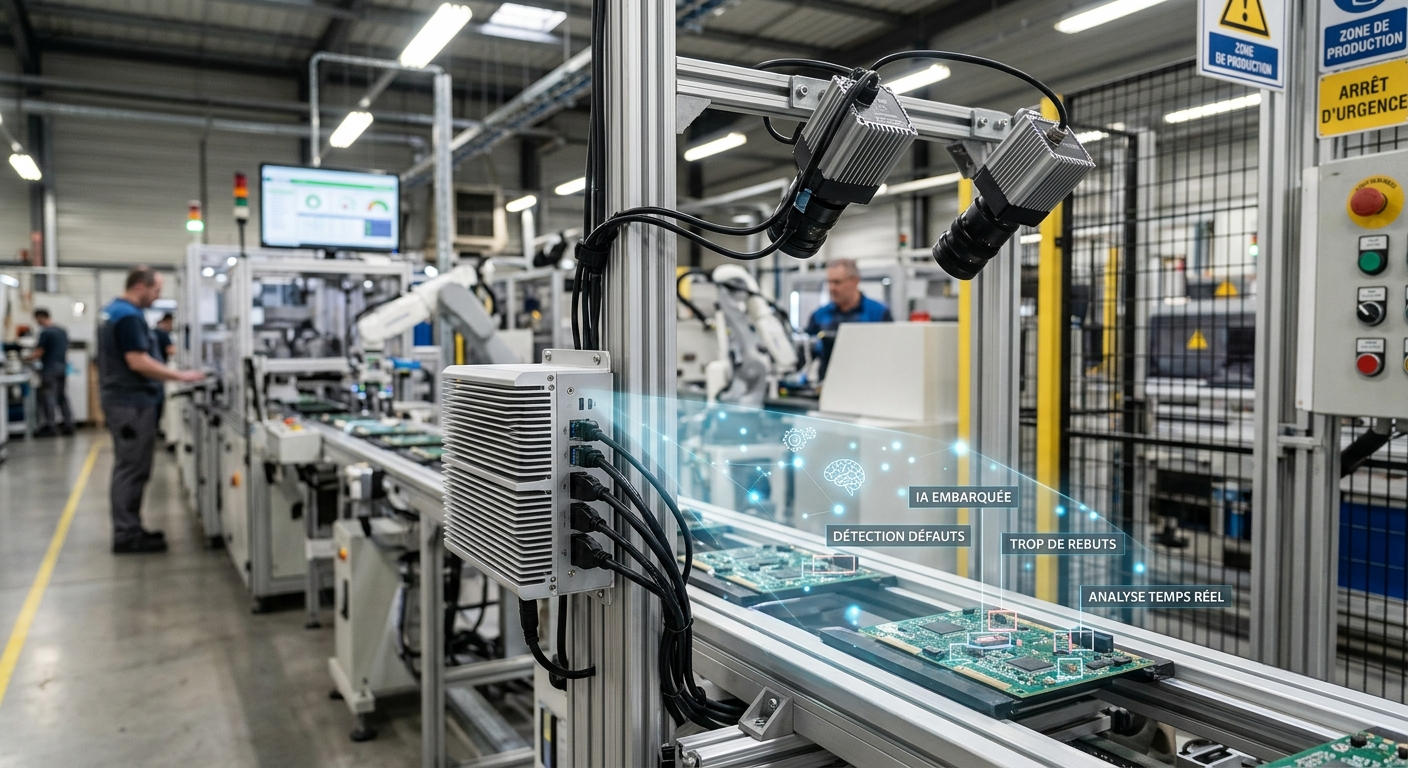
Machine vision is one of the most demanding use cases for a fanless PC. A machine vision architecture involves more than just running an AI model. The system typically must perform several successive operations: image acquisition, video stream transfer, preprocessing, inference, analysis of results, and communication with the industrial system.
The PC must therefore be sized according to:
- the number of cameras;
- their resolution;
- their frame rate;
- the volume of data generated;
- the type of processing performed;
- the expected response time;
- the AI model used;
- the available interfaces.
An application with a single camera performing a one-time inspection will obviously not have the same requirements as a quality control system equipped with multiple cameras operating continuously.
Industrial Application: Selecting a Fanless PC for Quality Control
Let’s consider a production line equipped with multiple cameras designed to automatically detect defects in parts.
The industrial PC must receive the video streams, preprocess the images, run the AI model, and then transmit the results to the production system. If the processing must be completed in a few tens of milliseconds, an architecture designed solely for monitoring will not necessarily be sufficient.
The choice may then shift toward:
- a multi-core processor capable of handling the various processing tasks;
- sufficient RAM for the software and models used;
- a GPU or AI accelerator for inference;
- Ethernet or PoE interfaces compatible with the cameras;
- sufficiently fast SSD storage;
- a cooling system capable of dissipating heat during continuous operation.
This example illustrates why the number of cores or the processor’s clock speed alone is not enough to determine the performance of an industrial PC for AI.
What interfaces are needed for machine vision?
Connectivity is another essential criterion. Depending on the architecture, a fanless PC for machine vision may require multiple Ethernet ports, Gigabit Ethernet or faster interfaces, USB 3.x ports, or even PoE interfaces that allow certain devices to be powered directly from the network.
The number and speed of the interfaces must be considered during the design phase to prevent a network bottleneck from limiting system performance.
In certain applications, expansion capabilities are also important. PCIe slots, in particular, can be used to add acquisition cards, additional network interfaces, or accelerators, depending on the PC’s architecture.
Memory and storage: Components That Should Not Be Underestimated
Processor or GPU power alone is not enough to guarantee the performance of a fanless industrial PC. RAM must be sized appropriately for the operating system, industrial software, AI models, and the data being processed simultaneously.
For machine vision, storage can also be a key consideration. Images and video streams can quickly generate large volumes of data, especially when results must be retained to ensure traceability or enable subsequent analysis.
Industrial SSDs, particularly those in the NVMe format, depending on the configuration, can deliver the performance required for applications that demand fast data access. Sizingmust therefore take into account storage capacity, performance, and the constraints of continuous operation.
Edge AI: processing data as close as possible to the machine
One of the main advantages of fanless Edge Computing PCs is bringing processing closer to the data source.
Take, for example, a camera installed on a production line. The images can be analyzed directly by the industrial PC to identify a defect. The system can then transmit only the relevant result to the PLC, MES, or supervisory system: compliant product, defect detected, type of anomaly, or measurement obtained. This architecture avoids systematically transmitting all images to a remote server.
It can therefore be particularly relevant for:
- automated quality control;
- defect detection;
- predictive maintenance;
- equipment monitoring;
- process analysis;
- anomaly detection;
- robotics;
- IIoT applications.
Thermal performance remains critical in fanless systems
One of the main challenges of a high-performance industrial fanless PC is thermal management. An AI or computer vision application can place heavy demands on the processor and GPU for extended periods. The passive cooling system must therefore be designed to efficiently dissipate heat.
In particular, the following factors must be taken into account:
- the thermal power of the components;
- the ambient temperature;
- airflow around the enclosure;
- the installation method;
- the continuous computational load;
- space constraints;
- the maximum permissible temperature.
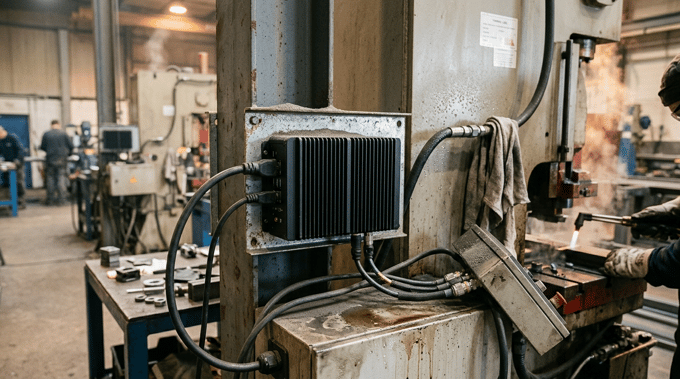
A high-performance fanless PC in a laboratory environment may not deliver the same performance in a hot industrial enclosure or in a machine exposed to high temperatures. The performance of a fanless PC should therefore never be considered in isolation from its installation environment.
How do you select a fanless PC for AI?
The design process should start with the application, not with a specific processor model.
1. Define the computational load
You must identify the software, algorithms, and models that will be run, as well as their level of demand. A simple detection application will not require the same resources as a video analysis system using multiple cameras.
2. Determine acceleration requirements
Depending on the AI model and the desired performance, the computation may be performed primarily on the CPU or may require a GPU or an AI accelerator.
3. Evaluate data flows
The number of cameras, resolutions, frame rates, and network interfaces directly determine connectivity and bandwidth requirements.
4. Check thermal constraints
The PC must be able to operate at the expected load under actual operating conditions, not just achieve peak performance for a short period of time.
5. Plan for the application’s evolution
For an industrial installation intended to operate for several years, it may be advisable to provide sufficient memory, storage, or expansion capacity to accommodate the evolution of software and AI models.
Fanless industrial PCs: what applications are suitable for Edge AI?
High-performance fanless architectures can meet a wide range of industrial needs.
Vision-based quality control
Cameras capture images of the products and transmit them to a PC. Vision and AI algorithms then automatically identify defects or anomalies.
Predictive maintenance
The PC collects data from the equipment and can apply models locally to detect abnormal behavior or early warning signs of failure.
-> Learn more about predictive maintenance
Video monitoring and analysis
Edge video analytics allows camera feeds to be processed directly, without necessarily transferring all the data to a remote infrastructure.
Robotics and automation
The industrial PC can perform tasks that complement those of the PLC or robot, particularly in the areas of machine vision, data analysis, or communication with various devices.
Edge computing and IIoT
The PC collects data from machines, aggregates it, analyzes it, and can transmit relevant information to supervisory systems, the MES, or cloud infrastructures.
What fanless PC series are available for edge computing and AI?
Today, there are several industrial fanless PC architectures suited for these applications, ranging from compact systems designed for edge computing to configurations that incorporate more powerful GPU or AI computing capabilities.
At Factory Systemes, the lineup includes solutions from Advantech, AAEON, Neousys Technology, 7STARLAKE, Winmate, and GALIUM, featuring various processor architectures, expansion capabilities, interfaces, and integration formats.
This diversity allows customers to select a configuration tailored to their specific application: edge computing, machine vision, automation, data acquisition, monitoring, or AI processing.
The choice should therefore not be based solely on the number of cores or the processor’s clock speed. It must take into account the entire architecture: computing, AI acceleration, memory, storage, connectivity, thermal management, power supply, and environmental conditions.
Fanless PCs and Edge AI: how to choose the right configuration?
An industrial fanless PC can serve perfectly as the core of an Edge Computing or Edge AI architecture, provided it is properly sized.
For an industrial application, the key criteria are rarely limited to raw processing power. Reliability during continuous operation, thermal management, communication interfaces, expandability, and compatibility with AI software and models are just as important.
For amachinevisionor Edge AIapplication, the specifications must include, in particular:
- the number of cameras and data sources;
- the resolutions and acquisition rates;
- the AI models used;
- the expected performance and latency levels;
- CPU, GPU, or AI acceleration requirements;
- the required memory and storage;
- communication interfaces;
- temperature and environmental constraints;
- the system’s scalability.
The right fanless PC is therefore not necessarily the most powerful one: it is the one whose architecture precisely matches the computational load and constraints of the industrial application.
At Factory Systemes, we can assist you in selecting the right fanless PC for edge computing, AI, or machine vision, taking into account your application’s computing requirements, interfaces, installation environment, and operational constraints.
FAQ – Industrial fanless PCs, Edge computing and AI
Can an industrial fanless PC run AI?
Yes. Some industrial fanless PCs are designed to run artificial intelligence models directly at the edge, particularly for inference, machine vision, and data analysis. Actual performance depends on the processor, GPU, or integrated AI accelerator.
What is the difference between Edge AI and Cloud AI?
Edge AI performs inference directly at the location where the data is generated, while Cloud AI relies on a remote infrastructure. Edge AI helps reduce latency and limit data transfer, among other benefits.
Can a fanless PC handle multiple industrial cameras?
Yes, provided its connectivity and computing capabilities are scaled accordingly. The number of cameras, their resolution, their frame rate, and the type of interface used must be taken into account.
Is a GPU required for machine vision?
Not necessarily. Some applications can run on a sufficiently powerful CPU. A GPU or AI accelerator becomes particularly useful when image processing or AI models require more parallel computing.
Why choose a fanless PC for industrial edge computing?
Passive cooling eliminates the fan and thus a moving mechanical part. This can be particularly well-suited for industrial environments subject to dust, vibrations, or continuous operation, provided the system’s thermal constraints are met.
How do you choose a fanless PC for an industrial AI application?
Start by defining the computational load, AI models, number of cameras or data sources, memory and storage requirements, communication interfaces, thermal constraints, and the installation environment. The processor or GPU should then be selected based on these requirements.