.svg)
.svg)
Windows 11 IoT Enterprise LTSC 2024 is a specialized edition of Windows designed for embedded and industrial systems, as well as mission-critical equipment that requires stability, security, and control over software updates.
Unlike Windows 11 Pro, which is geared toward office use and productivity, this LTSC (Long-Term Servicing Channel) edition prioritizes system longevity and minimizes feature updates.
1/ What is Windows 11 IoT Enterprise LTSC 2024?
Definition of the IoT Enterprise Edition
Windows 11 IoT Enterprise LTSC 2024 is a version of Windows designed for embedded systems, industrial equipment, and specialized devices. It is based on the LTSC (Long-Term Servicing Channel), ensuring a stable system that remains unchanged over time.
Who is this version intended for?
This edition is particularly well-suited for:
- OEMs
- Industrial integrators
- Medical device manufacturers
- Operators of interactive kiosks
- Edge and IoT solution providers
Differences from Standard Windows Enterprise
Unlike standard Windows Enterprise, the LTSC version:
- Does not include feature updates
- Guarantees an extended lifecycle
- Enables advanced system locking
- Offers improved application stability
2/ Why compare Windows 11 IoT LTSC and Windows 11 Pro?
Differences in Use
Windows 11 Pro is designed for:
- Office workstations
- Professional users
- Environments requiring frequent updates
Windows 11 IoT LTSC is intended for:
- Mission-critical systems
- Industrial control systems
- Embedded devices
- Platforms requiring stability and certification
Industrial and OEM Challenges
In industrial environments, each update may require:
- A complete software validation
- Regulatory recertification
- A production shutdown
LTSC stability therefore becomes a strategic issue.
3/ The 11 Benefits of Windows 11 IoT Enterprise LTSC 2024
1. Extended lifecycle of up to 10 years
-> LTSC support period
Windows 11 IoT Enterprise LTSC 2024 offers support for up to 10 years, including maintenance and security updates.
-> Comparison with Windows 11 Pro
Windows 11 Pro has a much shorter support cycle, generally limited to 24 months per version.
-> Impact on total cost of ownership
An extended lifecycle allows for:
- Fewer OS migrations
- Lower validation costs
- Maintained application compatibility
2. No mandatory feature updates
-> Difference between feature updates and security patches
Windows 11 IoT LTSC receives only critical and security updates. In contrast, Windows 11 Pro regularly includes new features that may impact stability.
-> Impact on industrial validation
This enables:
- Complete control over the software lifecycle
- Reduced risk of regression
- Improved operational continuity
3. Streamlined system and optimized performance
-> Removal of non-essential components
Windows 11 IoT LTSC can operate without:
- Consumer apps
- Non-industrial services
- Microsoft Store, depending on configuration
-> Performance gains
This optimization results in:
- Reduced memory footprint
- Faster startup
- Improved availability of system resources
-> Reduced attack surface
Fewer installed components also mean fewer potential vulnerabilities.
4. Advanced system lockdown features
-> Kiosk mode and restricted access
Windows IoT allows you to configure single-application systems for interactive kiosks or dedicated terminals.
-> Unified Write Filter (UWF)
This technology protects the system against unauthorized modifications and automatically restores it to its original state.
-> Advanced application control
AppLocker and Windows Defender Application Control allow you to restrict execution to authorized applications.
5. Enhanced security for critical systems
Windows 11 IoT LTSC includes:
-> Data protection
- BitLocker
- Secure Boot
- Credential Guard
-> Application control
- Device Guard
- Windows Defender Application Control
-> Adaptation to industrial hardware constraints
Certain configurations allow for greater hardware flexibility than Windows Pro.
6. Long-term application compatibility
-> API Stability
The LTSC version maintains a static software environment.
-> Driver and line-of-business software compatibility
Certified applications can remain operational throughout the product’s lifecycle.
7. Full customization of the user experience
-> Dedicated business interface
Manufacturers can:
- Remove the standard Windows desktop
- Launch a business application directly
- Customize the graphical user interface
-> Startup automation
Windows IoT enables advanced management of automatic login and application launch.
8. Full control over deployment and updates
Organizations can:
- Control which patches are installed
- Deploy custom system images
- Ensure reproducibility across an entire fleet of devices
9. Long-term availability for OEMs
Windows 11 IoT LTSC ensures:
- Stable license availability
- Consistency across hardware platforms
- Simplified product support
10. Optimization for regulated environments
This version facilitates compliance in sectors such as:
- The medical industry
- Transportation
- Defense
- Gaming and payment terminals
- Manufacturing
11. Support for modern Edge and IoT scenarios
Windows 11 IoT LTSC 2024 enables:
- Extended medical support
- Virtualization and containerization
- Management via Azure and Intune
- Compatibility with x64 and ARM architectures
3/ Real-world use cases for Windows 11 IoT LTSC
- Interactive terminals and kiosks
- Industrial controllers
- Medical devices
- Embedded transportation systems
- Payment terminals
Comparison Chart: Windows 11 IoT LTSC 2024 vs. Windows 11 Pro
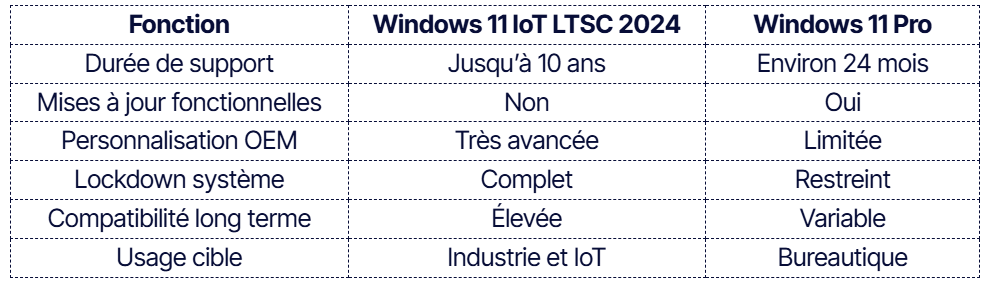
Windows 11 IoT Enterprise LTSC 2024 is an ideal solution for environments requiring stability, security, and control over the software lifecycle. It is a strategic choice for manufacturers and operators of critical systems.
Windows 11 Pro, on the other hand, remains a suitable solution for user workstations that require regular functional updates.
Windows 11 IoT Enterprise LTSC FAQ:
-> How long is Windows 11 IoT LTSC 2024 supported?
The LTSC version is supported for up to 10 years.
-> Does Windows IoT LTSC include the Microsoft Store?
No, it is generally absent or disabled to ensure system stability.
-> Does Windows IoT LTSC require a TPM?
That depends on the hardware configurations and security policies in place.
-> Can you migrate from Windows 10 IoT?
Yes, provided there is hardware and software compatibility.