.svg)
.svg)
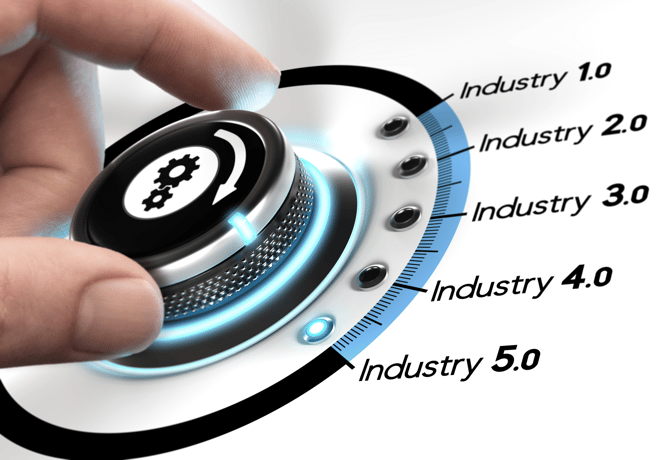
Industry 4.0 has revolutionized the industrial sector by introducing automation, connectivity, and big data analytics into factories. Industry 5.0 builds on this foundation, with one major change: it puts people back at the heart of industrial production.
In summary:
- Industry 4.0: industrial automation, connectivity, data, and smart manufacturing.
- Industry 5.0: human-machine collaboration, sustainability, and resilience, while retaining advanced industrial technologies.
Industry 5.0 does not replace Industry 4.0. It is the logical evolution of Industry 4.0, combining industrial performance, human expertise, and production continuity.
1/ Definition of Industry 5.0
Industry 5.0 refers to the evolution of future factories toward a model in which digital technologies directly support human work, rather than replacing it.
It is based on four main pillars:
- Human-Machine Collaboration
Operators work with collaborative robots, ergonomic human-machine interfaces (HMIs), and decision-support systems.
- Sustainable performance
Reducing the energy footprint, making better use of resources, and integrating environmental considerations from the very beginning of the process design. - Industrial resilience and flexibility
Ability to adapt quickly to fluctuations in demand, production uncertainties, and supply chain constraints. - Smart Data Utilization
Combined use of industrial IoT, edge computing, and predictive analytics to improve local decision-making.
In this model, the operator becomes a co-pilot of industrial systems, capable of interacting effectively with industrial technologies.
2/ Industrial Context and Business Challenges
The Contribution of Industry 4.0
Since 2010,Industry 4.0 has enabled:
- Connectivity between machines and IT systems
- Industrial automation of production lines
- The collection and analysis of massive amounts of data to optimize production and the supply chain
These advances have improved the performance, quality, traceability, and reliability of industrial facilities.
However, in some factories, this increased automation has sometimes led to:
- increased system complexity,
- difficulties for operators in getting up to speed,
- ergonomic and training challenges.
Why is Industry 5.0 becoming essential?
For industrial decision-makers, Industry 5.0 addresses three strategic challenges:
1 - Sustainable performance
Keeping costs under control while reducing environmental impact.
2 - Production continuity and reliability
Reintroducing the human element to increase flexibility and limit critical errors.
3 - ROI, security, and compliance
Combining digital technologies and human expertise to reduce operational risks and improve return on investment.
3/ Key Differences Between Industry 4.0 and Industry 5.0
| Aspect | Industry 4.0 | Industry 5.0 |
|---|---|---|
| Focus | Automation and data | Human-Machine Collaboration |
| Key Technology | IoT, MES, ERP, autonomous robots | IoT sensors, edge computing, industrial PCs, industrial HMIs |
| Objective | Performance and Efficiency | Performance, sustainability, and operator well-being |
| Flexibility | Limited to automated systems | Rapid adaptation through human input and intelligent automation |
| Sustainability | Not a priority | Integrated into the industrial strategy |
Operation and Key Principles of Industry 5.0
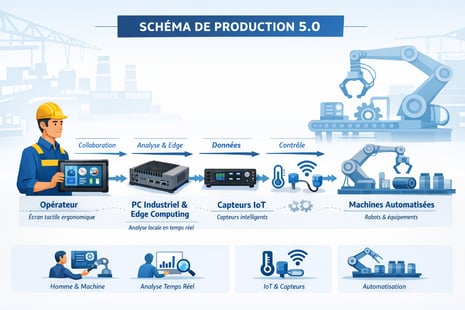
The implementation of Industry 5.0 is based on a pragmatic, often incremental, architecture.
Key Components
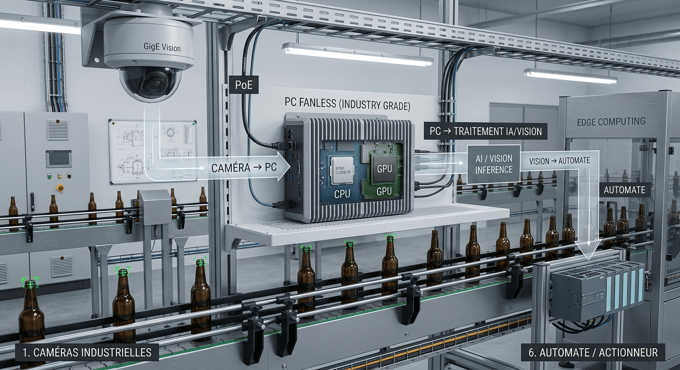
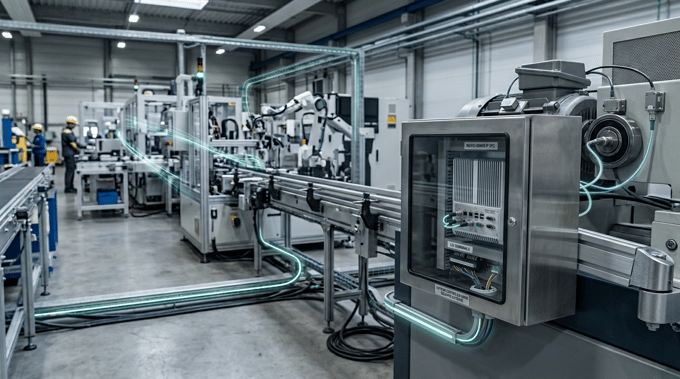
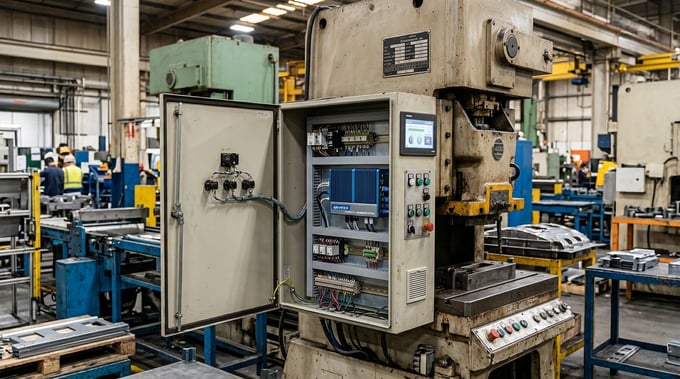
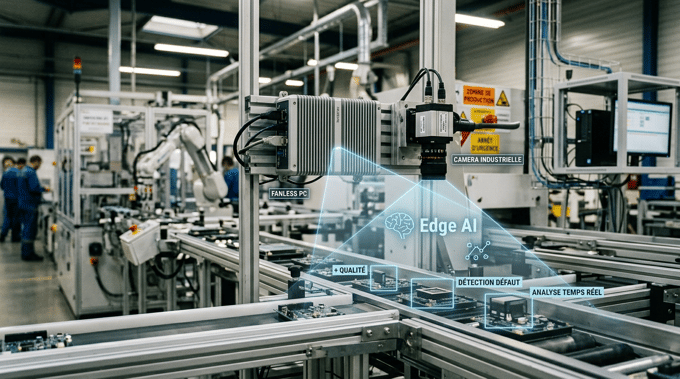
- Industrial PCs and edge computing
For local monitoring, real-time data processing, and production continuity, even in the event of a network outage.
- Sensors and Industrial IoT
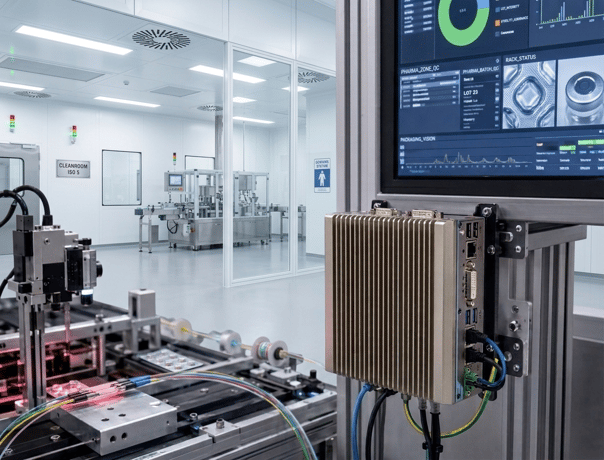
To collect reliable data on machine status, quality, and energy consumption. - Human-Machine Interfaces (HMIs)
Panel PCs, industrial displays, or rugged tablets that make it easier for operators to work in the field. - Collaborative robots
Assistance with repetitive, tedious, or low-value-added tasks.
Simplified diagram of Industry 5.0:
Tangible benefits for manufacturers
- Reduced production downtime through predictive maintenance.
- Optimization of costs and energy consumption through smart resource management.
- Improved product quality and traceability.
- Operational flexibility to adapt to changes in demand and unforeseen events.
- Enhanced safety: ergonomic interfaces and proactive alerts for operators.
Some industrial use cases
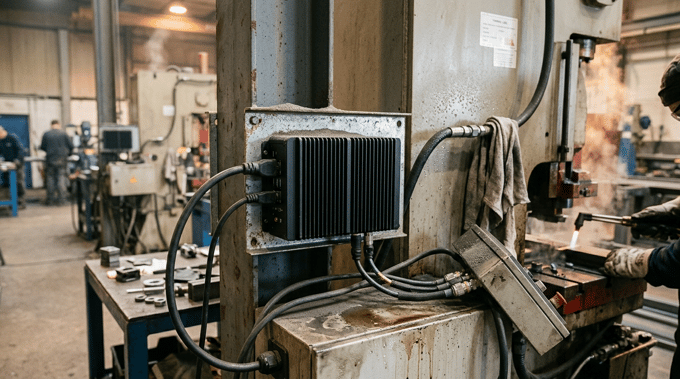
1. Production line in an SME
Deployment of a fanless PC and IoT sensors for local monitoring.
Result: Greater operator autonomy and a 25% reduction in downtime.
2. Multi-line monitoring
Use of rugged tablets to control multiple production lines.
Result: Faster decision-making, improved safety, and better on-site coordination.
3. Predictive maintenance
Analysis of machine data via edge computing to anticipate maintenance needs.
Result: Lower maintenance costs and improved equipment availability.
Industry 5.0 is not a radical break, but rather the natural evolution of Industry 4.0. It addresses the limitations of pure automation by putting people back at the center of smart manufacturing, while retaining existing technological advancements.
For manufacturers, this is a pragmatic approach aimed at balancing performance, sustainability, resilience, security, and ROI in an increasingly demanding industrial environment.
Industry FAQ
1. What is the main difference between Industry 4.0 and 5.0?
Industry 4.0 focuses on automation and data, while Industry 5.0 reintroduces humans as co-pilots of industrial systems.
2. How can Industry 5.0 be integrated into an existing factory?
Start by identifying critical processes, gradually introduce HMIs and IoT sensors, and train your operators.
3. What are the essential technological tools?
Industrial PCs, edge computing, IoT sensors, collaborative robots, and ergonomic operator interfaces.
4. What immediate benefits can be expected?
Reduced downtime, cost optimization, operational flexibility, and enhanced safety.
5. Is Industry 5.0 suitable for small and medium-sized enterprises (SMEs)?
Yes, it can be rolled out gradually using modular solutions tailored to existing production lines.
See also:
- Why Is a Rugged Tablet Essential for Industry 4.0?
- Industry 4.0: How Industrial Digitalization Boosts Performance
- The Benefits of the Industry of the Future