.svg)
.svg)
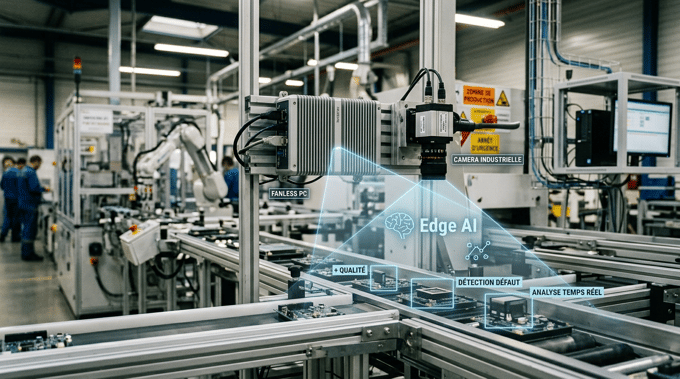
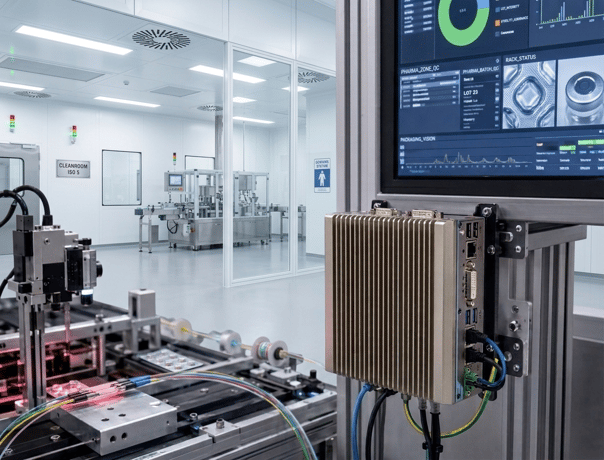
Predictive maintenance relies on the use of data generated by industrial machines. But between the measurement taken by a sensor and the maintenance decision, one step plays a crucial role: the processing of machine data. In this architecture, a fanless industrial PC can serve as a true edge device, capable of collecting, preprocessing, and analyzing data as close as possible to the equipment.
This approach helps reduce unnecessary data flows, minimize latency, and make certain information immediately actionable by monitoring systems, IoT platforms, or maintenance teams.
⇒ Key takeaway: An industrial fanless PC enables machine data to be processed as close as possible to the equipment. When combined with edge computing, it reduces data traffic, minimizes latency, and facilitates the integration of predictive maintenance into existing industrial facilities.
TABLE OF CONTENTS:
1. From Machine data to predictive maintenance
2. The fanless PC as an Edge device for data processing
3.Why process machine data locally?
4.Why choose a fanless PC for a predictive maintenance application?
5.Fanless PCs and predictive maintenance: How should the data be processed?
6.What are the benefits for maintenance teams?
7. Use case: monitoring an industrial motor with a fanless PC
8.How do you choose a fanless PC for machine data processing?
9.Fanless PCs, Edge computing, and predictive maintenance: a single data architecture
From machine data to predictive maintenance
Industrial equipment constantly generates a wealth of data: temperature, vibrations, pressure,rotational speed, power consumption, number of cycles, and machine status. These measurements serve as essential raw data for identifying deviations and anticipating certain failures.
However, leveraging this data presents a broader challenge for manufacturers, particularly when some of the collected information remains difficult to analyze effectively. But raw data alone does not yet constitute maintenance information. To become actionable, it must be collected, structured, and—depending on the application—processed locally before being transmitted to a higher-level system.
Collection alone is not enough
A predictive maintenance architecture can involve several steps:
Measure → collect → filter → process → analyze → detect an anomaly → transmit information → decide on a course of action
The sensor provides the measurement. The data acquisition system or gateway handles the collection. Computer processing then transforms this data into actionable indicators. It is precisely at this stage that an industrial fanless PC can be used.
What data can be utilized?
Depending on the equipment and monitoring objectives, the data may come from:
- temperature sensors;
- vibration sensors;
- pressure sensors;
- electrical measurements;
- cycle counters;
- industrial controllers;
- data acquisition systems;
- communications equipment.
The goal is not necessarily to transmit all of this data to a remote server. Some of it can be processed directly at the machine or production line level.
The fanless PC as an Edge device for data processing
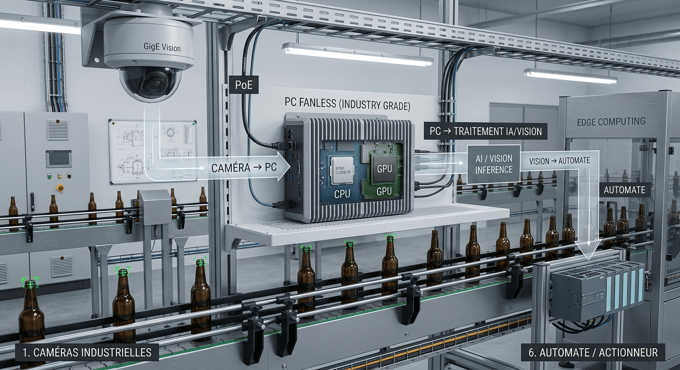
In anindustrial edge computing architecture , part of the computing is performed as close as possible to the data source. The fanless PC can thus serve as a bridge between field devices and higher-level IT systems.
Its role can be described simply as follows:
Sensors / machines
↓
Controllers / data acquisition systems
↓
Fanless Edge PCs
Data collection • filtering • computation • local analysis
↓
SCADA / MES / IoT platform / Cloud
↓
Predictive maintenance
This architecture allows processing tasks to be distributed between the field and central infrastructure.
Collect data as close to the machines as possible
The industrial PC can retrieve information from various devices depending on the interfaces and protocols used in the facility. Ethernet, serial ports, USB, GPIO, CAN bus, or other interfaces may be required depending on the application. The fanless PC thus serves as a hub for multiple industrial data sources.
Preprocess data locally
Preprocessing is one of the main functions that can be performed at the edge. Before sending the data to a central system, the PC can, for example:
- filter out unnecessary or outlier values;
- aggregate measurements;
- calculate averages or indicators;
- compare values to thresholds;
- identify unusual trends;
- convert or structure data;
- select information to share;
- store certain data locally.
Processing therefore does not necessarily involve performing the entire predictive analysis on the PC. It may involve an initial level of processing, intended to transform raw data into information that is more relevant for downstream systems.
Why process machine data locally?
Edge computing addresses a simple issue: not all data generated by a machine needs to be systematically sent to a server or the cloud.
A system with numerous IoT sensors can generate a large volume of data. Continuously transmitting every measurement can increase network traffic and complicate data processing. Local processing, on the other hand, brings part of the analysis closer to the field.
Reducing data traffic
The fanless PC can filter out the truly useful information before transmitting it. For example, rather than sending every raw reading from a vibration sensor, an edge application can calculate various metrics locally and transmit only the results needed for monitoring or maintenance. The amount of data transferred can thus be reduced depending on the chosen architecture.
Reducing latency
When information needs to be obtained quickly, local processing eliminates the need to rely on a round trip to a remote infrastructure. A significant variation can be detected directly at the line level and transmitted immediately to the relevant system.
This proximity is particularly valuable for industrial applications requiring continuous monitoring.
Continuing certain processing operations in the event of a communication failure
An edge architecture can also maintain certain functions locally when a connection to a remote server or cloud platform is temporarily unavailable. This approach aligns with industrial retrofit initiatives, which allow an existing facility to be upgraded without necessarily replacing all of its equipment.
The exact behavior naturally depends on the software and architecture in place, but local processing ensures that not all functions rely on a remote infrastructure.
Why choose a fanless PC for a predictive maintenance application?
The hardware responsible for processing machine data must itself be suited to industrial conditions. An industrial fanless PC offers several features that are ideal for an installation operating in close proximity to the equipment.
Continuous operation
Industrial monitoring applications may run continuously, sometimes 24 hours a day. The PC must therefore be designed for this type of use and offer a level of reliability consistent with the installation’s requirements.
The absence of a fan is also an advantage in certain environments, particularly by reducing the risks associated with clogging of a mechanical cooling system.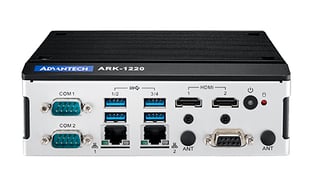
A design suited to the industrial environment
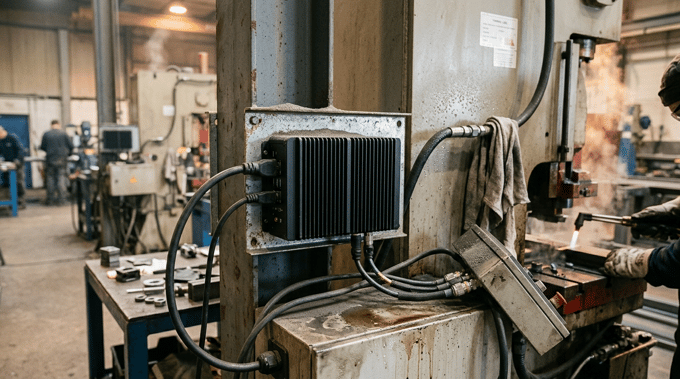
A computer installed near a machine may be subject to fluctuating temperatures, vibrations, dust, or space constraints.
Fanless industrial PCs are designed with varying levels of ruggedness and protection. However, the choice must be based on the actual installation conditions: temperature, vibration, humidity, dust, power supply, and available space.
Integration as close to the field as possible
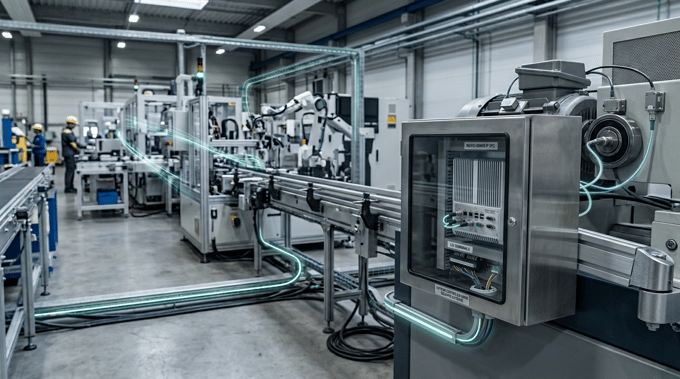
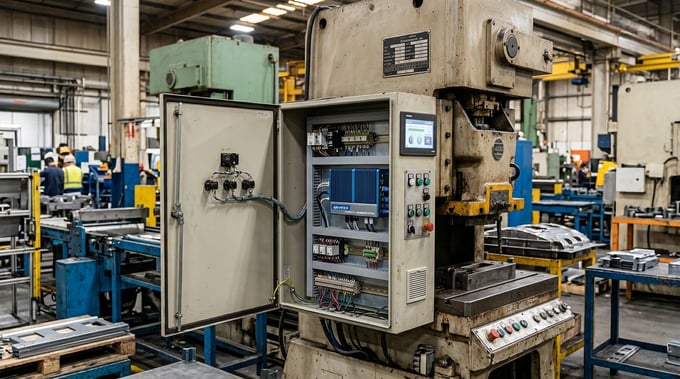
The compact form factors and various mounting options available for industrial PCs make it easy to integrate them into a cabinet, a machine, or a production facility. This proximity to the equipment is particularly well-suited to an edge architecture, in which part of the processing is performed directly on-site.
Fanless PCs and predictive maintenance: How should data be processed?
Local data processing depends heavily on the application. It can be relatively simple when it involves monitoring thresholds or calculating a few metrics. It can become much more demanding when it involves analyzing large volumes of data or running more complex algorithms.
An edge architecture can, in particular, perform the following:
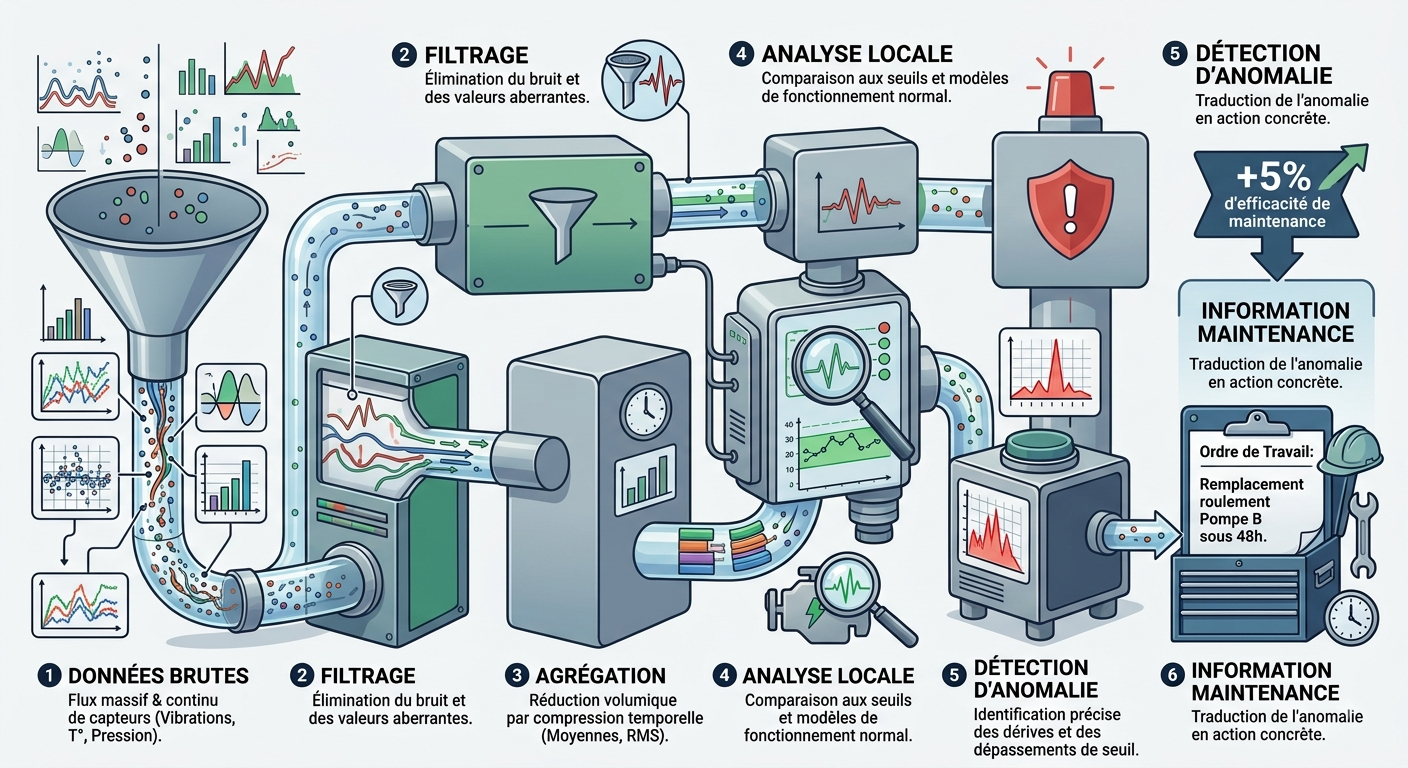
1. Data acquisition
Retrieving data from sensors, PLCs, and equipment.
2. Data cleaning
Filtering out inconsistent, incomplete, or unnecessary data.
3. Aggregation
Grouping metrics to obtain actionable indicators.
4. Analysis
Application of rules, thresholds, or algorithms to identify unusual trends.
5. Transmission
Sending relevant information to the SCADA system, MES, IoT platform, or the cloud.
6. Action
Triggering an alert or transmitting the information to the relevant teams.
This workflow clearly distinguishes data collection from data processing and analysis for maintenance purposes.
How does this benefit maintenance teams?
Local data processing does not replace a comprehensive predictive maintenance strategy. It serves as a technical building block that makes this strategy actionable in the field.
Identify certain deviations more quickly
Gradual changes in temperature, vibration, or power consumption of a piece of equipment can be detected based on the collected data. The Edge system can calculate the necessary metrics and flag any deviation that exceeds the rules defined for the application.
Facilitate the prioritization of interventions
Not all variations require immediate action. By providing contextualized information to maintenance teams, the architecture can help distinguish between a one-time variation and a trend that requires investigation.
The decision ultimately depends on business rules, the criticality of the equipment, and the production context.
Anticipating certain interventions
When a deviation is detected early enough, an intervention can potentially be scheduled rather than performed after a failure. The goal of predictive maintenance is thus to have information that allows for better anticipation of equipment condition.
Application example: monitoring an industrial motor with a fanless PC
Let’s consider a production line equipped with several motors. Sensors measure their temperature and vibration levels. The data is collected by an industrial fanless PC installed near the equipment.
Data processing can then follow several steps:
1. Retrieve data from the sensors;
- 2. Verify its consistency;
- 3. Calculate metrics;
- 4. Compare the values with defined reference values;
- 5. Detect unusual changes;
- 6. Send an alert or indicator to the monitoring system;
- 7. Store certain data for later analysis.
During normal operation, the PC continues to monitor the system. If a deviation develops gradually, the information can be sent to the maintenance platform so that teams can decide whether to perform an inspection or schedule a service call.
In this example, the fanless PC is therefore not necessarily the system that makes the maintenance decision on its own. It serves as the local computing component that transforms field data into actionable information.
How do you choose a fanless PC for machine data processing?
The choice of PC should be based on the actual needs of the application, not solely on processor power.
To learn more about the various selection criteria, see our guide at on how to choose an industrial fanless PC.
Computing power
The system configuration depends on the tasks to be performed: simple data acquisition, monitoring, calculation of indicators, local analysis, or execution of more complex algorithms. Some applications requiring greater processing power can also rely on architectures that incorporate GPU or GPGPU capabilities.
Memory and storage
Memory must be suited to the software running simultaneously. Storage, on the other hand, depends on the volume of data stored locally, the frequency of writes, and availability requirements.
For certain applications, architectures with multiple storage devices or RAID may be appropriate.
Connectivity
The PC must be able to communicate with the equipment in the installation. The number and type of available interfaces are therefore critical: Ethernet, serial ports, USB, GPIO, CAN bus, or specific interfaces as needed.
Environmental conditions
Temperature, vibration, dust, humidity, and space requirements must be included in the specifications. A fanless PC intended for an industrial edge application must be selected based on its actual operating environment.
Longevity
A predictive maintenance architecture is generally designed to operate over several years. Component availability, remote management, expandability, and hardware longevity are therefore important criteria when selecting an industrial PC.
Fanless PCs, Edge computing, and predictive maintenance: a single data architecture
The role of an industrial fanless PC in a predictive maintenance architecture is not limited to providing computing power. Installed as close as possible to the equipment, it can handle the collection, preprocessing, and some of the analysis of machine data before it is transmitted to central systems.
This approach enables the creation of an architecture in which each level plays a specific role:
- Sensors measure.
- PLCs and data acquisition systems collect data.
- The fanless Edge PC processes data locally.
- SCADA, MES, or IoT systems centralize and analyze the information.
- Maintenance teams use this data to make decisions.
For manufacturers looking to expand their use of predictive maintenance, the choice of IT hardware must therefore be considered as part of the overall data architecture.
The specifications of the PC will depend, in particular, on the computational load, the volume of data, the required interfaces, the installation conditions, and the expected level of availability.
The fanless industrial PC is an essential component for bringing data processing closer to production equipment. By combining data collection, local processing, and edge computing, it helps make machine data more quickly usable for predictive maintenance. The selection of an industrial fanless PC must therefore be part of an overall architecture tailored to the constraints and objectives of each industrial facility.
FAQ – Fanless PCs and predictive maintenance
Can a fanless PC be used for predictive maintenance?
Yes. An industrial fanless PC can collect and process data from sensors, PLCs, and connected devices. Depending on the application, it can preprocess data, calculate metrics, or detect certain anomalies before transmitting the information to a maintenance platform.
What is the role of an industrial PC in an edge architecture?
The industrial edge PC processes data as close as possible to the equipment that generates it. It can collect and filter data, perform various calculations, or conduct local analysis before transmitting the necessary information to a SCADA system, an MES, an IoT platform, or a cloud infrastructure.
Why process machine data locally?
Local processing helps limit the transmission of raw data to central infrastructures and reduces latency for certain applications. It can also allow certain processing functions to be retained locally when communication with a remote system is temporarily unavailable.
Can a fanless PC communicate with an industrial PLC?
Yes, depending on its hardware and software configuration. Industrial PCs can feature various communication interfaces, including Ethernet, serial ports, USB, or GPIO. The choice depends on the equipment, protocols, and the system’s architecture.
What is the difference between a fanless PC, an IoT gateway, and an industrial server?
These devices may have complementary functions. An IoT gateway is generally designed for data collection and transmission. A fanless industrial PC can offer greater processing power and enable the execution of edge applications directly in the field. An industrial server is better suited for applications requiring more computing power, storage, or virtualization resources.
See also:
- Fanless industrial PCs and retrofits: How to modernize an existing machine?
- Fanless PCs in industrial environments: dust, temperature, vibrations, and humidity
- Fanless industrial PCs: What performance levels are suitable for edge computing and AI?
- Fanless PCs or ventilated PCs: Which one should you choose for an industrial application?
- How to choose a fanless industrial PC for your application?