.svg)
.svg)
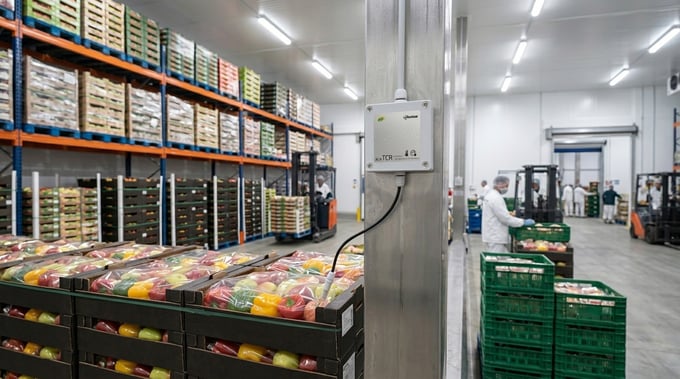
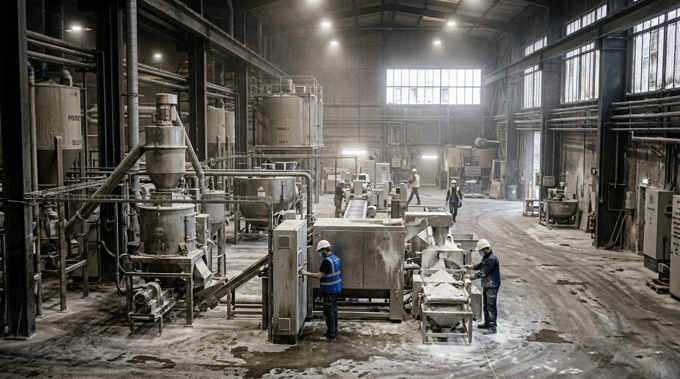
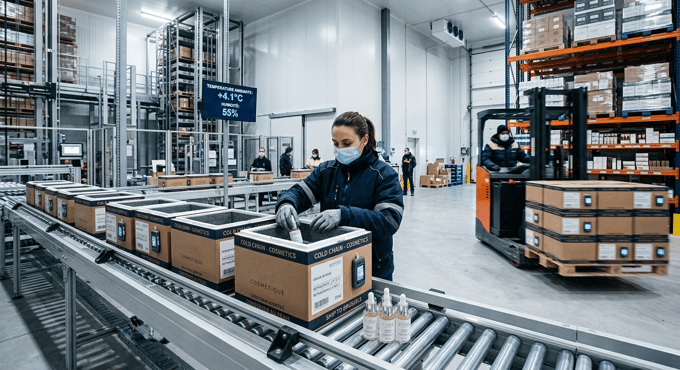
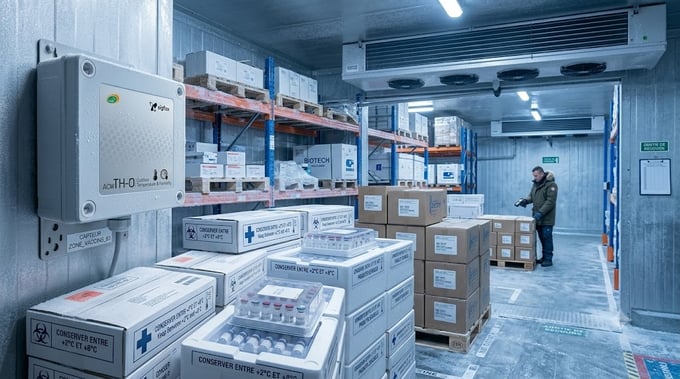
The industrial temperature and humidity monitoring system is used to continuously monitor environmental conditions in production, storage and transport areas, in order to guarantee the conformity of sensitive products.
It is used to avoid invisible drifts that can alter a product without any immediate visible sign, particularly in the food, pharmaceutical and logistics sectors.
What does it do?
To detect thermal and hygrometric deviations likely to impact product quality or regulatory compliance.
Why is it critical?
Because the majority of non-conformities in the cold chain do not stem from outright breaks, but from cumulative, undetected micro deviations.
How can it be used?
Through continuous measurement, analysis of critical zones and auditable traceability.
Cold chain: understanding the real causes of invisible breaks
Mistakes don't always come from the equipment
On most industrial sites, refrigeration systems operate correctly. Yet non-conformities do occur. The main cause is not technical, but operational: it's the operating conditions that create the discrepancies.
Repeated opening of doors, disorganized logistics flows or waiting times in buffer zones expose products to rapid variations in temperature and humidity. These variations are often too short to trigger an alert, but sufficient to alter a product.
The phenomenon of cumulative micro-exposure
A cold chain may be compliant on average, but not in reality. A product may undergo :
- several minutes out of range during transfers,
- repeated variations over several stages,
- localized deviations not visible in the overall data.
It is the accumulation of these micro-exposures that creates the most costly non-compliances.
3 common errors in industrial temperature and humidity monitoring
1. Measuring in the wrong place
One of the most common errors is the incorrect positioning of IoT sensors. A measurement taken in the center of a volume does not reflect critical areas:
- areas close to doors,
- areas of air flow,
- thermal stagnation zones.
The result: "compliant" but unrepresentative data.
2. Confusing average with operational reality
Another common mistake is to analyze temperature averages. However, an average can mask :
- short but critical peaks,
- rapid variations during openings,
- localized variations in a precise zone.
In the cold chain, it's extremes, not averages, that determine compliance.
3. Neglecting humidity in risk analysis
Humidity is often overlooked or under-exploited in monitoring plans. Yet it is directly linked to :
- condensation on cold surfaces,
- packaging degradation
- microbial proliferation,
- corrosion of certain industrial products.
Cold chain non-compliance: why is it detected too late?
A control logic that's still too ad hoc
In many organizations, inspections are carried out on a sampling or periodic basis. This approach fails to detect short but critical events.
The gap between physical reality and data reading
A product may appear to be compliant on a tracking chart, yet have been subjected to out-of-tolerance conditions.
This can be explained by :
- a lack of temporal granularity,
- a lack of sensors in certain areas,
- excessive data aggregation.
This discrepancy is a major cause of non-compliance during audits.
Critical zones in the cold chain: where drifts occur
Logistical interfaces are the hot spots
The main risks do not lie in the cold equipment itself, but in the transitions between them:
- loading bays
- transfer zones between buildings
- pre-shipment waiting periods
- temporary storage outside controlled areas
These areas are subject to rapid heat exchange, which is difficult to stabilize.
Condensation and thermal inertia: two key phenomena
Two physical phenomena account for much of the drift:
1. Thermal inertia delays temperature stabilization after opening or transfer.
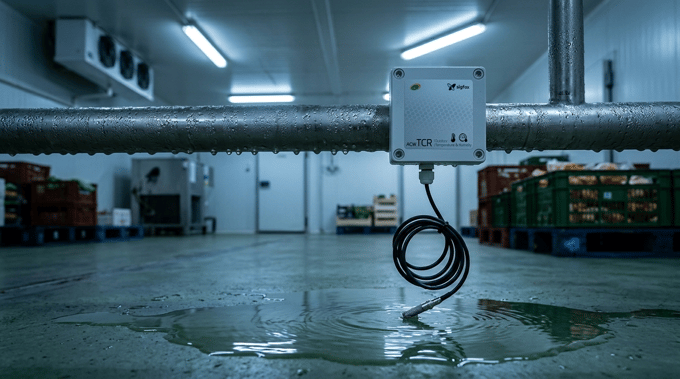
2. Condensation occurs when warm, moist air comes into contact with cold surfaces, creating localized areas of deterioration that are often invisible when viewed from the outside.
Temperature and humidity monitoring in industry: role in regulatory compliance
A requirement of quality standards
Temperature and humidity monitoring in industry is essential to meet :
- HACCP (food safety)
- GMP (pharmaceutical industry)
- ISO 22000 (food safety)
- temperature-controlled logistics requirements
Compliance based on proof
In regulated environments, compliance no longer depends solely on compliance with conditions, but on the ability to demonstrate them.
Tracking systems provide time-stamped histories, temperature and humidity curves, and auditable evidence. Without these elements, a simple uncertainty can call into question an entire batch.
How to reduce cold chain non-conformities
Identify the really critical areas
The areas at risk are not always those that are monitored first and foremost. Deviations often occur at interfaces and temporary zones, which must be included in the monitoring plan.
Adapt measurement granularity
Effective monitoring relies on an adequate sensor mesh, continuous measurement and analysis of rapid variations (not averages).
Integrate humidity into quality control
The addition of humidity monitoring enables you to anticipate condensation phenomena, invisible slow degradation and packaging non-conformities.
3 industrial applications
1. In the food industry, monitoring mainly concerns fresh and frozen products exposed to variations during logistical handling.
2. In pharmaceuticals, it is critical for heat-sensitive products requiring strict traceability of storage conditions.
3. In logistics, it secures multi-site flows and transfers between zones with different temperatures.
Temperature and humidity monitoring in industry is an essential lever for avoiding invisible non-conformities linked to the cold chain. It enables the detection of small but repeated deviations, often located in logistical interface zones, and ensures complete traceability, essential in a regulated context.
In an industrial environment where proof is becoming as important as control, this monitoring is a central tool for securing operations and product conformity.
FAQ :
Why can a cold chain be non-compliant without a visible break?
Because repeated micro-exposures can degrade a product without any immediate warning.
What are the most critical points?
Logistical interfaces: docks, transfers, buffer zones and temporary storage.
Is humidity really a factor in non-compliance?
Yes, it can cause condensation, packaging degradation and contamination.
Why do audits reveal late deviations?
Because of a lack of granularity and continuous traceability of actual conditions.