.svg)
.svg)
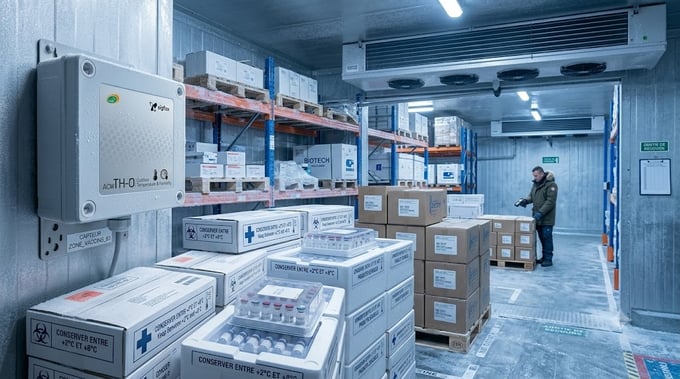
A break in the cold chain is an interruption or drift in the temperature of a heat-sensitive product outside the defined thresholds, compromising its conformity, safety and quality. It is most often the result of a failure to monitor and control environmental parameters, particularly temperature and humidity, throughout the supply chain.
In environments related to Industry 4.0 (food processing, pharmaceuticals, cosmetics, temperature-controlled logistics), the cold chain is a critical risk control system. It guarantees regulatory compliance (HACCP, ISO 22000, GDP), production continuity and protection of sensitive products.
What is the purpose of the cold chain?
Maintain a controlled temperature to preserve the physico-chemical and microbiological properties of products.
Why is it critical?
Because temperature drift can lead to :
- batch loss
- regulatory non-compliance
- stoppage of logistics flows
- significant financial losses
How to implement it?
By combining real-time supervision, instrumentation, maintenance and traceability.
Industrial and regulatory challenges of the cold chain
Applicable standards
The cold chain is governed by several standards:
- HACCP (food safety)
- ISO 22000 (food safety management)
- GDP (Good Distribution Practices - pharmaceuticals)
- ATP (temperature-controlled transport)
These standards require temperature control, traceability of measurements and proof of compliance in the event of an audit.
Industrial impact of a cold chain breakdown
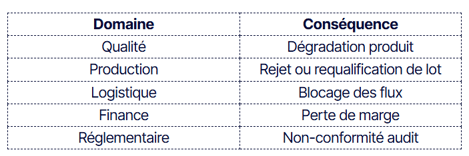
Industrial orders of magnitude
- Food industry: losses of several thousand to tens of thousands of €.
- Pharmaceuticals: losses in excess of €100,000 per critical batch
- Energy: +10 to +25% in the event of uncontrolled thermal drifts
Modern industrial cold chain architecture (IoT & supervision)
Data chain and technical architecture
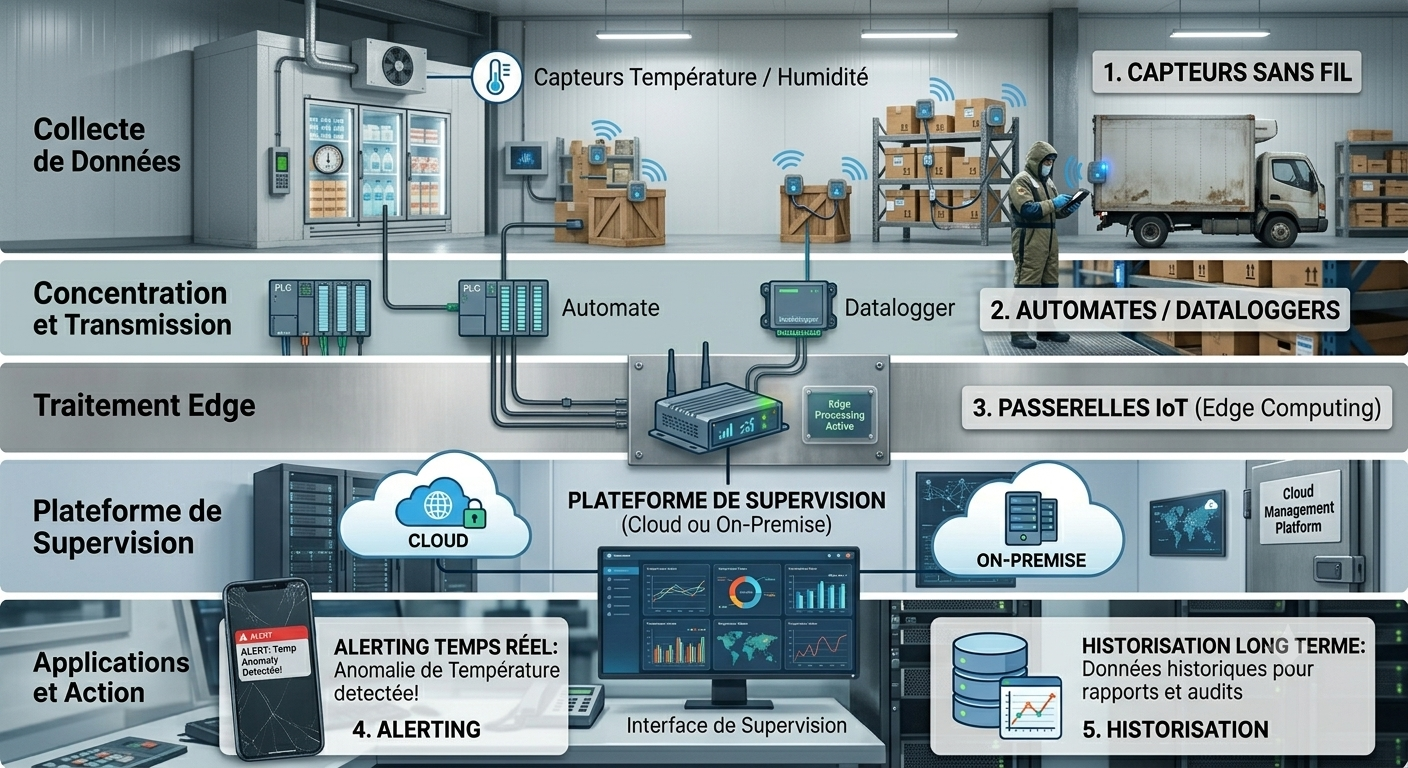
Industrial supervision objectives
Real-time supervision enables immediate detection of drifts, by identifying deviations as soon as they appear. It reduces MTTD (reaction time) thanks to instantaneous alerts, and facilitates rapid intervention.
It helps anticipate breakdowns by analyzing weak signals from IoT equipment (thermal variations, performance drifts). This approach also enables energy optimization by adjusting plant operation to actual needs.
Finally, it guarantees automated audit compliance thanks to centralized data historization and continuous event traceability (HACCP, ISO 22000, GDP).
The 5 critical errors that can lead to a break in the cold chain
1. Lack of real-time temperature monitoring
Description
Installations still too often operate in "historical" mode (deferred reading of data).
Consequences
- late detection (hours or even days)
- loss of irrecoverable batches
- no immediate warning
- invisible energy drifts
Critical KPI
A target MTTD (Mean Time To Detect) of less than 5 minutes.2. Poor thermal mapping of critical areas
Description
Temperatures vary greatly depending on position in a cold zone.
Causes
- poorly controlled air flow
- door openings
- storage overload
- incorrectly positioned sensors
Industrial effects
- invisible non-compliant zones
- non-representative audits
- quality validation errors
3. Insufficient maintenance of refrigeration equipment
Description
Equipment drifts progressively before breakdown.
Weak signals
- higher energy consumption (+5 to +15%)
- irregular cold cycles
- variation in thermal stability
Consequences
A gradual, undetected break in the cold chain.
4. Poor management of out-of-cold exposure times.
Description
Quay phases are underestimated in the supply chain.
Common causes
- desynchronization of logistics flows
- quay congestion
- lack of operational KPIs
Recommended KPI
Maximum exposure of sensitive products within 10 minutes.
5. Under-exploitation of traceability data
Description
Data are collected but not analyzed.
Problems
- lack of predictive analysis
- inability to identify recurring drifts
- loss of value of historical data
Invisible errors detected in industrial audits
Inconsistent or incomplete data
Data reliability is essential to ensure cold chain compliance. Gaps in temperature histories, inaccurate time stamping or lack of sensor redundancy can compromise incident analysis and proof of compliance during an audit. Without continuous, reliable data, it becomes difficult to identify the origin of a thermal drift or to demonstrate compliance with storage conditions.
Lack of multi-variable correlation
In many facilities, only temperature is monitored. However, reliable cold chain analysis requires the correlation of several indicators, such as humidity, door openings and energy consumption. Without this multi-variable correlation, some causes of drift remain invisible, complicating the identification of incidents and the implementation of effective corrective actions.
Misconfigured thresholds
Poorly defined alarm thresholds reduce the effectiveness of coldchain monitoring . Overly broad alarms can delay detection of a real drift, while the absence of dynamic thresholds means that normal variations linked tooperating conditions cannot be taken into account. The result: over-frequent or irrelevant alerts, which end up being ignored by teams and reduce responsiveness to critical incidents.
How can you prevent a break in the cold chain over the long term?
Real-time, multi-level supervision
Effective cold chain supervision is based on a multi-level architecture combining IoT sensors in the field, edge computing devices, a centralized platform and an instant alert system. This organization enables data to be collected, processed and analyzed as close as possible to the equipment, while providing a global, consolidated view. It guarantees rapid detection of deviations and immediate reaction capability in the event of a critical incident.
Complete supply chain instrumentation
Reliable control of the cold chain relies on comprehensive instrumentation of the entire logistics flow. This includes the production, storage and transport phases, as well as all the intermediate zones that are often critical but insufficiently monitored. This global coverage guarantees continuity of measurement, identifies potential breaking points, and ensures complete traceability of temperature conditions throughout the product's journey.Data-driven predictive maintenance
Predictive maintenance relies on the continuous analysis of equipment data to anticipate failures before they occur. It relies in particular on the analysis of thermal trends, energy monitoring and the detection of progressive anomalies. This approach makes it possible to identify performance drifts at an early stage, to plan interventions at the right time, and to limit the risks of cold chain breakdowns linked to undetected failures.
Advanced data processing
Advanced data analysis can be used to identify critical zones, optimize energy consumption and drive continuous improvement. By analyzing historical data and correlations between different operating parameters, it becomes possible to better understand thermal behavior and reduce the risk of cold chain breakdowns.
Measurable industrial benefits
- 20% to 40% reduction in product losses
- fewer audit non-conformities
- improved logistics OEE
- 10 to 25% reduction in energy costs
- reduction in incident detection time
An industrial use case
Multi-temperature food processing platform
Initial situation
- lack of real-time supervision
- drifts on dock areas
- recurrent losses of fresh produce
Actions implemented
- multi-zone IoT sensors
- centralized supervision
- exposure time analysis
Results
- reduced losses
- improved thermal stability
- reduction in non-conformities
The break in the cold chain is rarely the result of an isolated incident. It is mainly due to a lack of visibility, inadequate instrumentation and limited use of industrial data.
Successful organizations stand out for their ability to transform the cold chain into a controlled, measurable and predictive system. The combination of real-time supervision, predictive maintenance and data processing is today's industry standard for securing operations over the long term.
FAQ - Understanding cold chain failure
What is a break in the cold chain?
It's an out-of-threshold thermal drift leading to a loss of product conformity.
What are the main causes?
Insufficient supervision, maintenance, logistics, instrumentation.
How can it be detected?
Via connected sensors and real-time supervision.
Which sectors are concerned?
Food, pharmaceuticals, cosmetics, logistics.
How can I avoid it?
Supervision + maintenance + traceability + data analysis.