.svg)
.svg)
Industrial humidity monitoring is the continuous measurement and analysis of water vapor content in the air of a production environment. It enables control of the physical conditions that influence product quality, equipment reliability and process stability.
It is based on three fundamental parameters: relative humidity, absolute humidity and dew point. These parameters are inextricably linked to temperature, as the capacity of air to hold water vapor depends directly on its thermal level.
In modern Industry 4.0 architectures, these data are integrated into supervision systems (SCADA, MES, industrial IoT) to detect environmental drifts in real time.
Understanding humidity monitoring in industry
Humidity monitoring consists in continuously measuring the hygrometric conditions of an industrial environment, to avoid invisible but critical drifts. Unlike a simple comfort measurement, it is an engineering parameter that directly influences :
- the physical stability of materials
- process behavior
- the reliability of electrical and mechanical equipment
In many industrial cases, humidity-related drifts are not immediately visible, but cause cumulative progressive degradation.
👉 Discover the industrial use case: Temperature and humidity monitoring and control
System vision
Humidity monitoring becomes a data stream integrated into a global architecture.
IoT sensors → edge computing → SCADA/MES supervision → predictive analysis
This approach enables :
- multi-variable correlation (T°, RH, pressure)
- early detection of environmental anomalies
- energy optimization of HVAC systems
- predictive maintenance based on hygrometric drifts
Why is humidity a critical parameter in industry?
The condensation phenomenon (dew point)
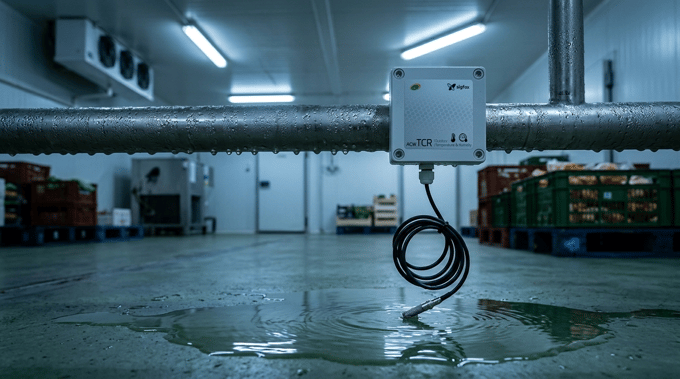
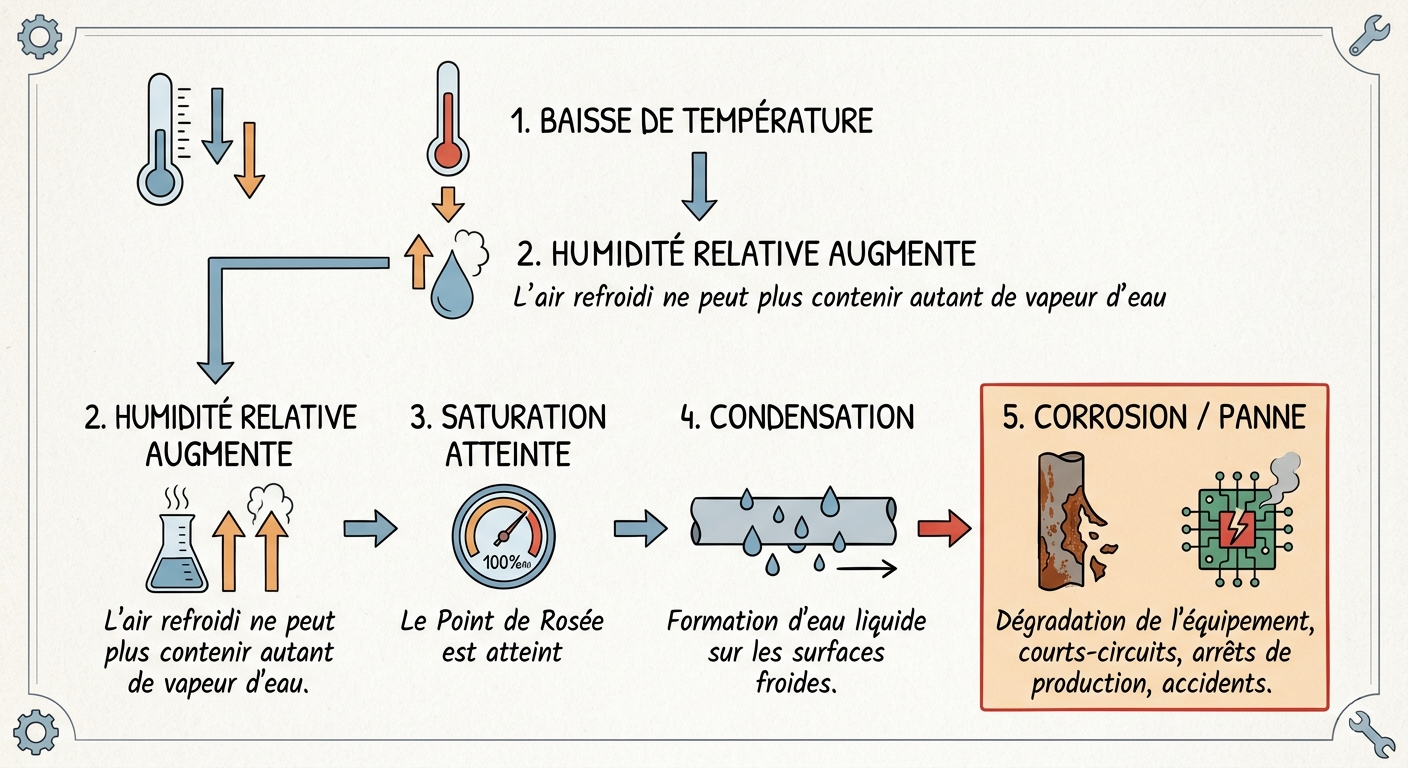
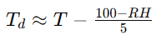
The dew point is the temperature at which air reaches 100% relative humidity. Above this threshold, water vapor turns into liquid water. This phenomenon is critical, as it often occurs invisibly, before material damage occurs.
Simplified dew point calculation
-> Industrial example:
- T (Temperature) = 25°C
- RH (Relative Humidity) = 60%.
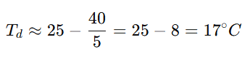
Result: any surface above 17°C becomes a potential condensation zone.
Actual industrial impact (orders of magnitude)
Industrial feedback shows that :
- up to 20-30% of electronic failures are linked to humidity or indirect condensation phenomena
- a variation of just 5-10% RH can be enough to alter the behavior of certain chemical or powder processes
- in compressed air environments, poor dew point control is a major cause of unplanned pneumatic shutdowns.
Industry standards and frameworks
Humidity monitoring is covered by a number of standards, such as ISO 14644 for cleanrooms, Good Manufacturing Practice (GMP) in the pharmaceutical industry, and good practice for industrial HVAC systems. It is also framed by the internal quality requirements of organizations, notably those of QA and QC departments. All these frameworks require rigorous, documented control of environmental conditions to guarantee process conformity and product quality.
Fundamental temperature/humidity relationship
Relative humidity depends directly on temperature. Two environments containing the same amount of water vapor can have very different relative humidities, depending on temperature.
What is the direct industrial consequence of this?
Temperature measurement alone is insufficient to characterize the risk of condensation or process drift.
Industrial reading of critical situations

Monitoring technologies and architecture
Humidity monitoring relies on a complete chain from physical measurement to data analysis.
Capacitive IoT objects are the most widely used in standard industry, while cooled mirror systems are reserved for high-precision applications such as industrial gases or laboratories.
These sensors are integrated into industrial systems via protocols such as Modbus, IO-Link or OPC-UA, and increasingly via MQTT in Industrie 4.0 architectures.
Industrial implementation methodology
The implementation of a humidity monitoring system follows a logic structured in four stages.
1. Analysis of critical zones
Identification of areas where humidity variations have a direct impact on :
- product quality
- sensitive equipment
- production flows
2. Definition of control thresholds
Control thresholds are defined on the basis of product-specific constraints, applicable regulatory standards and observed drift history. They enable monitoring to be adapted to actual process requirements and guarantee production stability.
3. Instrumentation and deployment
Sensor positioning is determined by taking into account thermal gradients, air stagnation zones and proximity to critical equipment. This ensures that measurements are representative of actual production environment conditions.
4. Data processing
Data are used for :
- drift detection
- real-time alerts
- long-term trend analysis
4 industrial use cases
Compressed air networks
In compressed air networks, dew point monitoring helps prevent the presence of liquid water in circuits, the main cause of pneumatic malfunctions.
Electronics industry
In the electronics industry, dew point monitoring reduces corrosion and improves the reliability of electronic boards.
Powder materials industry
In environments where powders are handled, it limits agglomeration and flow blockage phenomena.
High-precision environments
In high-precision environments, it is used as an indicator of environmental compliance in the same way as temperature.
Humidity monitoring in industry is a critical physical parameter in the same way as temperature. It has a direct impact on equipment reliability, process stability and product quality.
Its integration into Industrie 4.0 architectures transforms an invisible environmental variable into a real-time industrial control indicator. Manufacturers who structure this monitoring correctly have a concrete lever for reducing risks, improving quality and optimizing overall performance.
FAQ - Humidity monitoring in industry
Why is humidity a critical parameter in industry?
Because it directly influences condensation, corrosion and process stability, often invisibly.
What's the difference between relative humidity and dew point?
Relative humidity depends on temperature, while dew point indicates the actual condensation temperature.
Why measure temperature and humidity together?
Because temperature alters the air's capacity to hold water vapor, which completely changes the industrial risk.
What are the most sensitive sectors?
Electronics, chemicals, pharmaceuticals, compressed air environments and hygroscopic materials.
What precision is needed in industry?
From ±2% RH in standard environments to ±0.5% RH in critical or regulated environments.
How can these measurements be integrated into a connected factory?
Via industrial sensors connected to SCADA or IoT systems using Modbus, OPC-UA or MQTT.