.svg)
.svg)
Industrial retrofitting involves modernizing existing machines or production lines. This may involve replacing or upgrading certain components, without rebuilding the whole. Today, companies have to manage costs, cope with shortages of new equipment, and meet increasing performance and compliance requirements. In this context, retrofitting appears to be a credible alternative to complete replacement.
For manufacturers, it's not just a technical operation. It's a strategic lever. It extends equipment life, improves productivity and secures production.
Industrial issues: why is retrofit back at the heart of strategy?
Aging equipment that can still be used
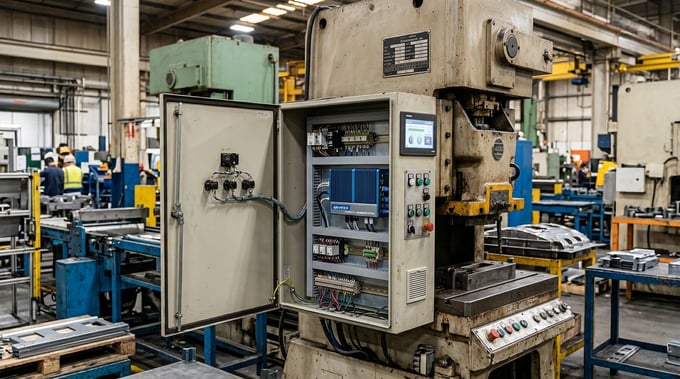
On many industrial sites, machines are 20 to 30 years old. Mechanics are often still sound, but critical components are aging fast. PLCs are no longer maintained, some drives are unavailable and industrial HMIs are outdated.
These limitations lead to frequent breakdowns, increase maintenance costs and disrupt production.
Economic pressure and investment constraints
Replacing a complete line is costly and entails lengthy production stoppages. There is also a high risk involved in integrating new systems.
Retrofitting therefore makes it possible to smooth out investments. It targets only the critical areas, and avoids the need to completely overhaul lines. It also enables essential components to be modernized rapidly.
Regulatory requirements and cybersecurity
Industrial standards are constantly evolving, with machine safety, traceability and cybersecurity taking center stage. Old equipment can quickly become non-compliant or vulnerable. Retrofitting offers the opportunity to integrate modern safety and monitoring devices, reducing risks and ensuring plant compliance.
Understanding industrial retrofit: how it works and its objectives
What is industrial retrofit?
Industrial retrofit involves modernizing existing equipment to improve its performance, reliability or compliance. The main structure of the machine remains intact. It's an effective compromise between corrective maintenance and complete replacement.
What does it actually do?
Retrofitting improves machine availability. It reduces maintenance costs and enables new functions to be added. It also extends equipment life and adapts production to new needs.
How does a retrofit project work?
A retrofit project goes through four stages. First, a technical audit identifies the state of the equipment, obsolete components and risks. Next, the scope of intervention is defined: automation, motorization, safety or supervision. The third stage consists of designing and migrating components, adapting programs and testing the system. Finally, commissioning includes a gradual restart and performance validation.
The different forms of industrial retrofit
Automation retrofit
The aim of this type of retrofit is to replace obsolete PLCs and modernize man-machine interfaces. It secures process control and simplifies maintenance.
Electrical and motor retrofit
This includes replacing drives, optimizing energy consumption and improving precision. These interventions increase performance and reduce equipment wear.
Supervision and digitalization retrofit
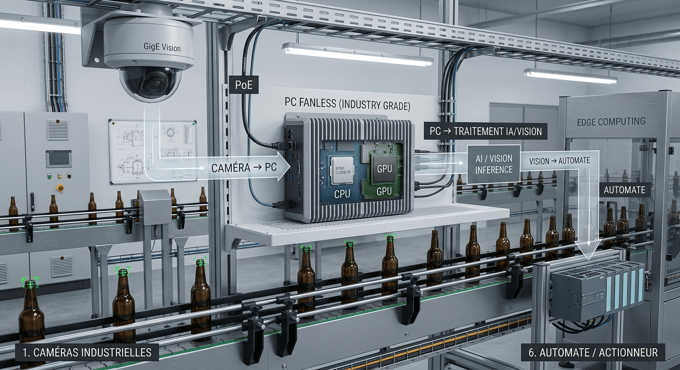
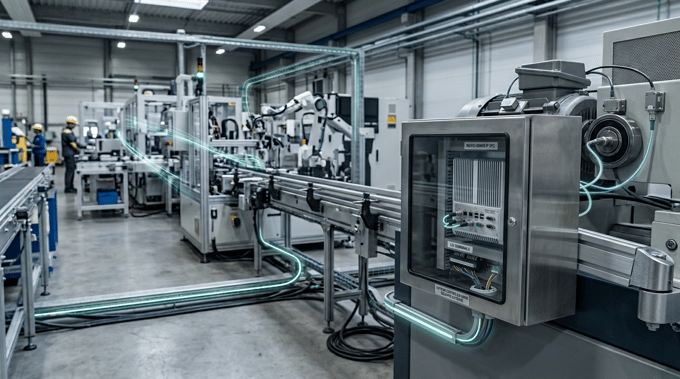
The integration of SCADA or IoT solutions enables production to be monitored in real time. This facilitates predictive maintenance and improves overall visibility of operations.
Safety retrofit
This type of project brings machines up to standard, adds safety features and ensures regulatory compliance. It reduces risks for operators.
Retrofit versus complete replacement
Retrofitting is less costly and requires shorter downtimes than complete replacement. It limits risks while improving performance and extending machine life.
Complete replacement offers maximum performance and a longer service life, but involves a major investment and prolonged downtime. In most cases, retrofitting is chosen when the mechanics are still sound and the obsolescence concerns only certain components.
What benefits can we expect from this initiative?
Retrofitting improves machine availability, so breakdowns are less frequent and production becomes more stable. Maintenance costs are reduced thanks to standardization of parts and better equipment documentation. Performance is also optimized, with faster cycles, greater precision and fewer rejects.
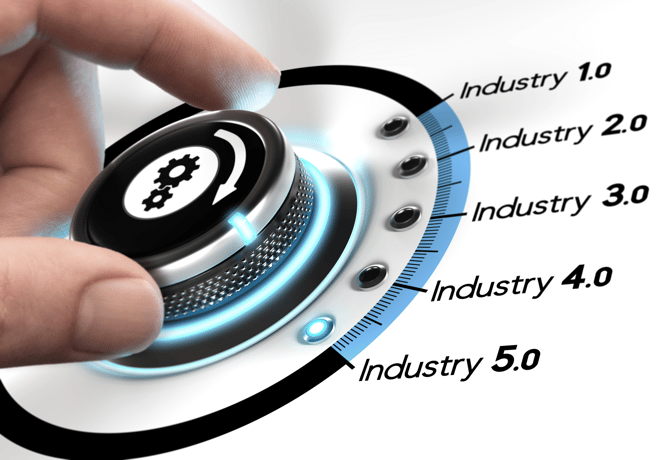
Compared with a complete replacement, retrofitting ensures faster, more economical production continuity. Above all, it facilitates access to industrial data, enabling real-time monitoring, effective supervision and the implementation of predictive maintenance strategies, consistent with the principles ofIndustry 4.0.
Case studies and impacts
Case 1: Food packaging line
A packaging line was experiencing frequent stoppages due to obsolete PLCs. Replacing the PLC and man-machine interface :
- reduced breakdowns by 30
- increased line availability by 15
- improved traceability, enabling 100% tracking of batches produced.
Case 2: Machine tool in the mechanical engineering industry
A machine tool equipped with old drives did not guarantee the necessary precision. Retrofitting the motorization and recalibration :
- improved dimensional accuracy from ±0.05 mm to ±0.01 mm
- reduced scrap by 25
- increased hourly output by 12
Case 3: Multi-station automated line
On a multi-station automated line, the absence of supervision was complicating control. The addition of a SCADA system :
- enabled real-time monitoring of all stations
- reduced unplanned downtime by 20
- improved the responsiveness of maintenance operations, reducing lead times from an average of 45 minutes to 15 minutes
Industrial retrofit is neither a simple upgrade nor a systematic revolution. It's a pragmatic approach to asset optimization. It secures production, controls investments and gradually modernizes facilities. Success depends on a structured approach, based on technical analysis and performance objectives.
FAQ
Is industrial retrofit profitable?
Yes, the return on investment depends on the cost of downtime, the criticality of the machine and the gains achieved.
How long does a retrofit project take?
It varies from a few days to several weeks, depending on complexity. Downtime is shorter than a complete replacement.
Is it possible to modernize without stopping production?
Partially. Certain stages can be prepared in advance, but a shutdown is often necessary for final integration.
Does retrofitting help to integrate Industry 4.0?
Yes. It is a key lever for connecting existing equipment and making it compatible with digitalization and predictive maintenance.
What are the risks involved?
The main risks are technical incompatibility, poorly defined scope and longer-than-expected downtime. A rigorous initial audit can help limit them.
See also:
- Why is industrial data still underutilized?
- End of Windows 10 Enterprise 2016 LTSB: anticipate the transition!
- Industry 4.0: digitizing an existing plant without replacing everything